Trading Strategy
A premium seller's field manual. How I sell options, in 7 layers, each one naming the failure it prevents.
Read it in your browserPDF · 11 pages · 137 KB · Edition 2
What's inside
- RegimeHow much to sell right now, and why low VIX means size down.
- Underlying selectionThe six checks a name must pass. The most important layer.
- Position sizingCapital as a filter, and why you start with one contract.
- Structure & timingWhich account, which structure, why about 7 days to expiry.
- Strike selectionStarting at 20 delta, when to tilt, and earnings.
- Position managementRoll, hold or cut, and managing the whole book's delta.
- Risk & marginStress-testing concentration and the vol-spike playbook.
Written for intermediate traders. New to options? Start with Options from zero first.
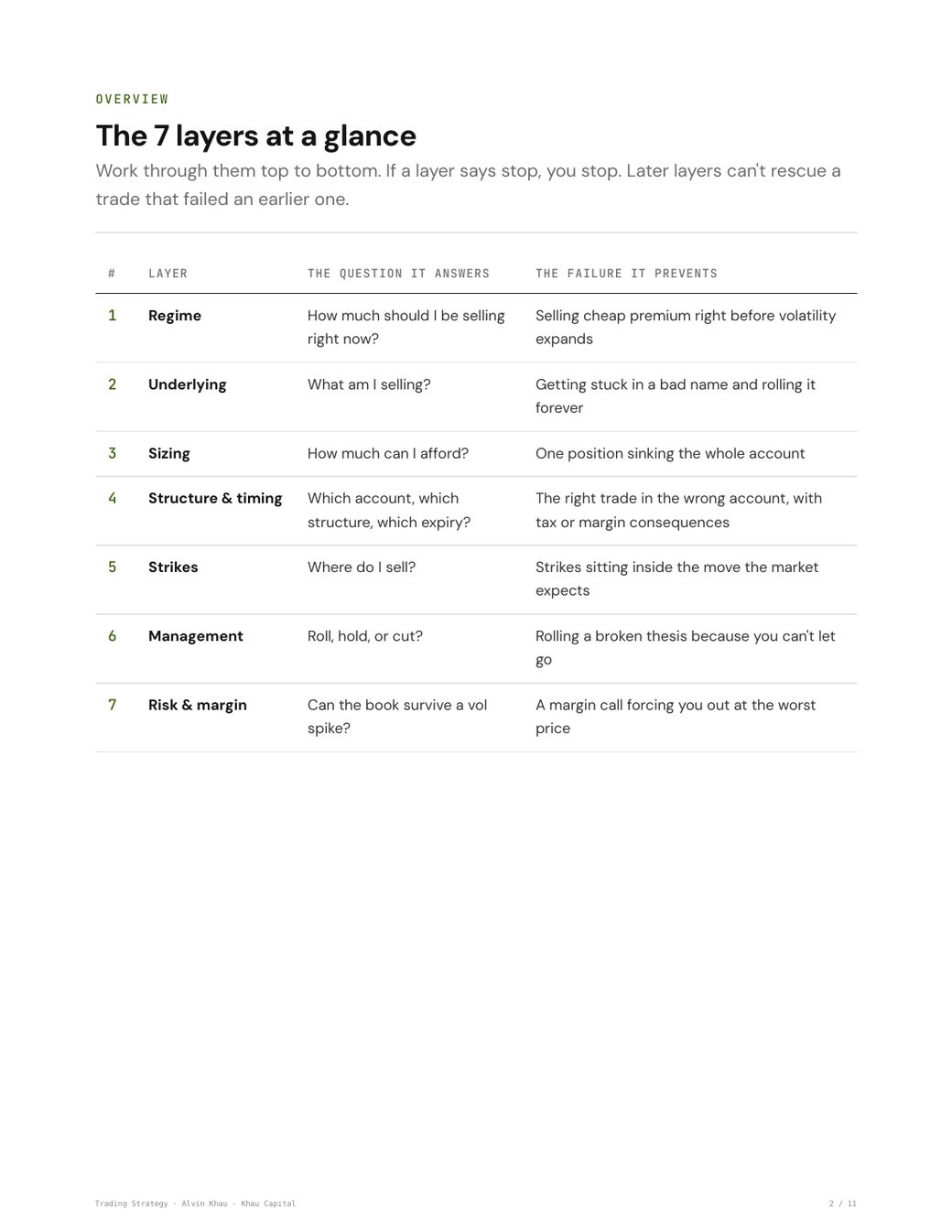
The 7 layers, in short
Same checks, same order, every trade. If a layer says stop, I stop. A later layer can't rescue a trade that failed an earlier one.
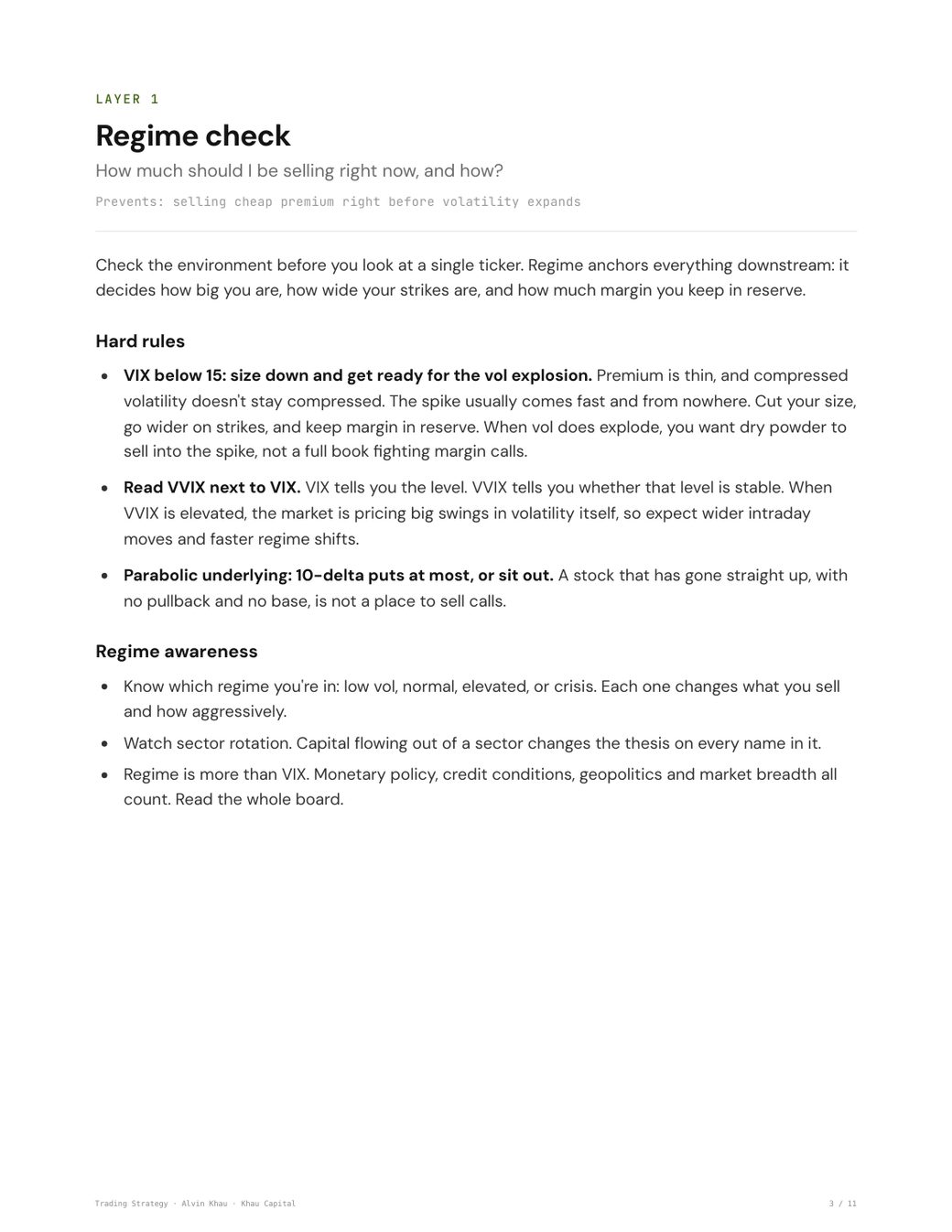
01Regime
Prevents: selling cheap premium right before volatility expands.
- VIX under 15: size down, go wider, keep margin in reserve. Compressed volatility doesn't stay compressed.
- Read VVIX next to VIX. VIX is the level. VVIX tells you whether the level will hold.
- Parabolic stock: 10-delta puts at most, no calls, or sit out.
02Underlying selection
Prevents: getting stuck in a bad name and rolling it forever.
- The most important layer. Picking the ticker is the edge. Everything after it is management.
- Six checks, all must pass: tight options liquidity, a higher-priced stock, US-listed, implied volatility above realized, a thesis you can say out loud, and you know how it moves.
- The #1 mistake: falling for a name and rolling a broken thesis. If the thesis breaks, cut it.
03Position sizing
Prevents: one position sinking the whole account.
- Share price × 100 is the cash behind one put. It has to fit without maxing margin.
- A $150 stock needs $15,000 per put, and realistically a $50,000+ account.
- Start with one contract. Scale with experience, not with account size.
04Structure & timing
Prevents: the right trade in the wrong account.
- RRSP: covered calls and cash-secured puts. TFSA: long-term shares and the odd covered call. CRA has reclassified high-volume TFSA trading as business income.
- Active selling lives in a non-registered or corporate account.
- My default in the corporation: short strangles about 7 days to expiry. 45 days is the ceiling, and only in registered accounts.
05Strike selection
Prevents: strikes sitting inside the move the market expects.
- Start at 20 delta on both sides: roughly a 20% chance of finishing in the money.
- Go wider when risk is up. Go tighter only with conviction.
- Around earnings, sell outside the implied move.
06Position management
Prevents: rolling a broken thesis because you can't let go.
- Every roll is a new trade. Roll before the strike is breached, not after.
- Hold to expiry by default. Cut when the thesis breaks, liquidity dries up or the capital has a better job.
- With several names, watch the whole book's net delta and steer it toward neutral.
07Risk & margin
Prevents: a margin call forcing you out at the worst price.
- Margin overrides everything. Before adding, ask: if my biggest name gaps overnight, what happens to my margin?
- Vol spike: close near-full-profit positions first, then roll the rest wider. Protection, rarely.
- The gap rule: after a 5% gap at the open, no changes for 60 minutes.
On April 23, layers 1, 2, 6 and 7 broke on the same day. The post-mortem shows how.
The PDF adds the account tables for Canada and the US, the sizing table, a one-page decision flow and plain-English definitions.
Read Trading StrategyFree PDF · opens in a new tab© 2026 Khau Capital Corp · Proprietary trading, own capital only. All rights reserved. Content is for educational and informational purposes only and is not investment, tax or legal advice or a recommendation to buy or sell any security. Past results do not indicate future results. Options trading involves substantial risk, including loss of more than your initial investment. By using this site, you agree to the Terms and Privacy Policy.